Robert Calvert of Great Harwood: A Search for Origins
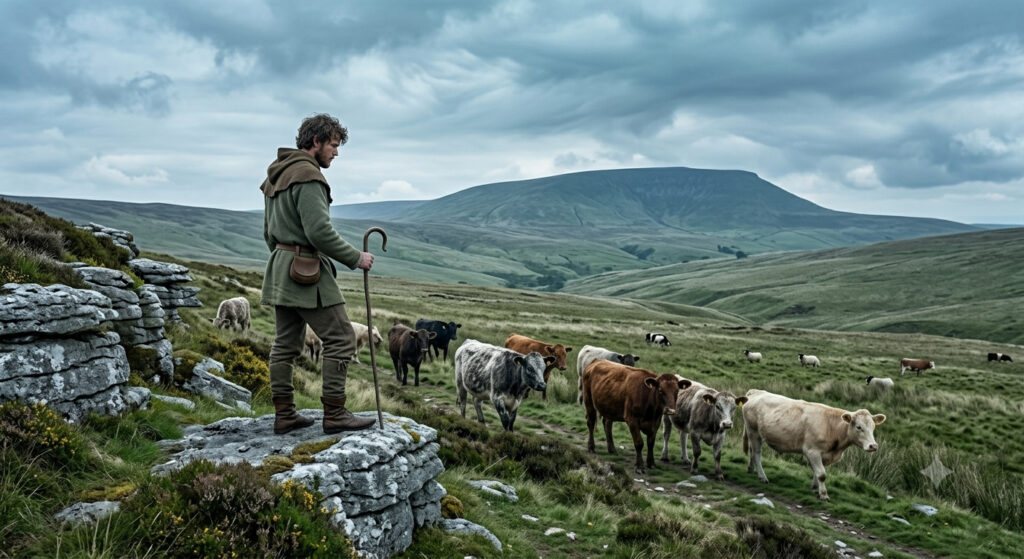
There are many people with deep roots in Great Harwood in Lancashire who trace their descent back to one Robert Calvert, who died there in 1718. Over the years a good deal of research has gone into the origins of Robert, who seems to have arrived in the town sometime after the Civil War, but a number of pedigrees now circulating online are not based in fact, and they have come to dominate the narrative.
This essay is an attempt to set the record straight. Over the years I have come to realise that, as others have observed, genealogy abhors a vacuum: where the records fall silent, conjecture rushes in to fill the gap. In Robert’s case there was a torrent of conjecture waiting to do exactly that. There is still no single piece of evidence that names Robert’s father outright, but I hope to show that the case set out here is a good deal more plausible than the pedigrees currently in circulation. Robert is my own ancestor, and my husband’s too, and I am content with the hypothesis put forward below, while being honest about where it remains a hypothesis and not a proven fact.
Rather than pick apart the current theories first, which risks being confusing, I will set out the case for Robert’s origins as I understand them, look at what can and cannot be known, and only then turn to the various myths that have grown up around him and explain where they seem to have gone wrong.
What the records can tell us
For a man born and living in seventeenth-century Lancashire, the records most likely to help are parish registers, probate documents, and land or property records. All three survive for the Calverts, but none of them survive completely, and it is worth being clear from the outset about their limits.
Parish registers were required to be kept from 1538, but survival is far from complete, and this is as true of Lancashire as anywhere. Blackburn’s own registers, which as the mother church of a wide area would have recorded many of the baptisms, marriages and burials for the surrounding chapelries, do not survive before 1600. Great Harwood and Whalley are unusual in having registers from an early date, which is a wonderful resource, but it also has a habit of misleading the unwary: because these two registers are more complete than most, researchers who fail to find an event where they expect it are often tempted to accept a plausible-looking entry from Whalley or Great Harwood instead, even where the family’s true home lay elsewhere. There are a good many pedigrees online that jump, without explanation, from a family several miles away to Whalley or Great Harwood around the turn of the seventeenth century, and this is very often the reason.
Registers that do survive are seldom complete even so. The years around 1621 to 1624 brought famine and disease to Lancashire, and the Great Harwood register itself falls silent for parts of those years; the neighbouring Altham register shows marriages and baptisms continuing but burials rising sharply, which is probably the truer picture of what was happening locally. The Civil War brought further disruption to registers across the county in the 1640s. And a further reason, relevant to this family in particular, was religion: Lancashire is well known to have harboured both Roman Catholic recusancy and Protestant Nonconformity well into the eighteenth century, and either could keep a family’s baptisms, marriages and burials out of the Anglican record. This point matters a good deal for Robert Calvert.
Where parish registers fail, probate documents, chiefly wills and the inventories that often accompany them, are the best resource for filling the gaps, and a search for the wills of a family’s likely kin can be very rewarding. Land records, too, can show transactions between family members and demonstrate connections between places that no other source records.
Robert Calvert of Great Harwood: what is known
Robert Calvert died in Great Harwood in 1718, having made his will the previous summer. He describes himself as a clothier, that is, someone who put out wool or yarn to be worked by others in their own homes and then took the finished cloth to market, a common trade in this part of Lancashire in the early eighteenth century.
No Calverts appear in either of the two post-Restoration tax listings for Great Harwood: not the Lay Subsidy of 1660, in which everyone over sixteen was liable, nor the Hearth Tax, assessed in Great Harwood in 1666. Both are valuable, name-rich sources, and their silence is itself informative. It tells us that Robert, or whichever Calvert first settled in the town, arrived after 1666, after the Restoration.
Mentions of Calverts in the Great Harwood parish register up to this point should be treated with caution. Great Harwood’s church was a chapel of ease within the ancient parish of Blackburn, serving both Great Harwood township and part of Rishton, and it is clear that people from the surrounding area used whichever chapel, Great Harwood, Blackburn itself, or one of the Whalley parish chapelries, suited them at the time. An early mention of the surname in the Great Harwood register is therefore not proof of residence there.
The first clear evidence of a settled Calvert family in the town comes from two baptisms:
Baptism: 25 Sep 1678, St Bartholomew, Great Harwood — Nicholas Calvert, son of Robt. Calvert, abode Harwood.
Baptism: 24 Feb 1680/1, St James, Church Kirk — Joshua Celvart, son of Robbart Celvart, abode Great Harwood.
That the second baptism took place at Church Kirk rather than at Great Harwood’s own church, despite the family’s abode being given as Great Harwood, is a small but telling detail, and one worth keeping in mind when the question of Robert’s religion is considered later.
The will of Robert Calvert, made on 20 June 1718 and proved on 1 May 1719, is the fullest single document relating to him:
“In the name of God Amen the 20 day of June in the yeare of our Lord 1718 I Robert Calvard of Harwood Magna in the County Lancaster clothier being infirme in body but of sound and perfect mind and memery thanks be to almighty god doe make publish and declare this my last will and Testament as followeth first I commend my soul to Almighty God my creator asueredly trusting through the meritorious death and passion of my Saviour and Redeemer Jesus Christ to be saved and my body to be buryed in such decent and Christian maner as my executors hereafter shall think fit… I give and bequeath to my son Joshua my bed as it stands and all my Clothes with the chest that they are in likewise the Cheare that I sit in and the great Bible. Item I give and bequeath to my daughter Marye my Trunk and that which is in it and the Table Cheare. Item I give to Robert my Desk. Item I give and bequeath to my son John one shilling to be paid within six months if he demands itt after my decease and whereas my son Jonathan now stand bound to me by Obligation conditioned for payments of six pounds a yeare for two years next to come I doe give and bequeath the same to Danial, Joshua, Obadiah, Jonathan, Samuall, Robert, Mary my sons and daughter equally to be divided amongst them…”
The will was witnessed by Alexander Marcer and John Polard, and proved by his sons Daniel and Joshua, named as executors. Robert signed with his mark rather than a signature, which was probably because of ill health or infirmity rather than illiteracy.
The names of Robert’s children, taken together, are striking: Nicholas, Joshua, Mary, Robert, John, Daniel, Obadiah, Jonathan and Samuel. Set aside Nicholas for a moment, and what remains is an unusually concentrated run of Old Testament names, Joshua, Obadiah, Jonathan, Samuel, Daniel, of a kind often found in households with Puritan or Nonconformist sympathies. The bequest of “the great Bible” to his son Joshua, and the will’s own language of trusting “through the meritorious death and passion of my Saviour and Redeemer Jesus Christ to be saved”, suggest a Protestant, evangelical choice of words. None of this proves Nonconformity on its own, but taken together with the gaps in the parish record discussed below, it forms a consistent pattern.
The Calvert surname and its Lancashire origins
The surname Calvert almost certainly arose independently in more than one place, since its original meaning, calf-herd, describes an occupation that could be taken up wherever cattle were kept. The Calverts who concern this essay descend, so far as the evidence allows us to say, from a family established in Lancashire, and probably from the area around Cockerham in the Lonsdale hundred, rather than from the Calverts of the North Riding of Yorkshire who produced George Calvert, first Lord Baltimore, and who gave their name to Calvert County, Maryland.
The Victoria County History records that Adam Calfherd and Maud his wife were living at Cockerham as early as 1363, when the abbot of Cockersand complained that Adam had cut down trees on abbey land, and again the following year when Adam and Maud were charged with trespassing on the abbey’s fishery. In 1458 the abbot and convent leased the whole manor and rectory of Cockerham to John Calverherd and his sons Thomas and William. The descent from calf-herd to Calvert, by way of Calverherd, shows the surname history, and it places the family’s roots firmly in pastoral farming on the Lancashire coast, not in Yorkshire.
By the following century the Cockerham family had grown prosperous. William Calvert was granted the farm and manor of Cockerham demesne in 1515, and in 1598 a John Calvert obtained a grant of arms on the strength of a claimed descent from the Calverley family of Calverley in Yorkshire. This claim was most probably untrue, whether or not John himself believed it: heralds of the period were not always rigorous, and a prosperous family with an eye to social advancement had every reason to reach for a grander pedigree. It is worth remembering this when we come, much later, to the modern pedigrees that make a very similar leap towards Lord Baltimore’s family.
Whatever the truth of the 1598 claim, the Cockerham Calverts remained a substantial, armigerous family in the Lonsdale area from monastic times until around the Civil War, and Cockersand Abbey itself is known to have had landholding connections with Great Mitton in the Ribble Valley, which may explain, at least in outline, how the surname came to appear inland.
Untangling two families: Lancashire and Yorkshire
Anyone researching the Calvert surname online will sooner or later be offered a route back to Lord Baltimore’s family: George Calvert, of Kiplin in the North Riding of Yorkshire, raised to the peerage in 1625, whose sons founded the colony of Maryland and gave their name to Calvert County. It is a tempting line to appropriate, but it is not, on the evidence available, Robert Calvert’s family.
The case for keeping the two families apart rests on geography as much as anything. Kiplin lies in Richmondshire, in the North Riding, the best part of seventy miles from the Ribble Valley, on the far side of the Pennines. The Lancashire Calverts, by contrast, can be traced with reasonable confidence from Cockerham on the Lancashire coast inland to the Blackburn Hundred over the course of the sixteenth century: a William Calvert holds the Cockerham demesne in 1515; a John Karvart is assessed on goods worth £4 in Blackburn in 1523; a William Calvard is named in a document concerning lands in Ribchester in 1543; the will of Thomas Calvard of Mellor is proved in 1608, naming his wife Agnes and children William, Anne, Margaret, Ellen and Jennet; and a John Calvard of Clayton le Dale is assessed on goods worth £3 a few years after that. This is short-range movement within Lancashire, not a migration across the Pennines from Yorkshire.
The Hearth Tax returns of the 1660s make the same point in a different way. By 1664, Calverts appear as a distinct cluster still resident at Cockerham itself: Richard Calvert, described as “gentleman”, with two hearths, together with Richard Calvert senior, John, Mary and Jane Calvert, all at Cockerham. A second, quite separate cluster appears across the Blackburn Hundred: Edmund Calvert at Harwood Parva (that is, Little Harwood, near Blackburn, and not to be confused with Great Harwood, where no Calverts appear on the tax at all), Thomas Calvert at Mellor, Thomas Calvert with two hearths and Richard Calvert with one at Clayton le Dale, Richard Calvert at Balderstone, and William Calvert at Blackburn itself. A third, smaller cluster sits further up the Ribble at West Bradford and Waddington, technically across the county boundary in the West Riding of Yorkshire, but socially and geographically part of the same Ribble Valley world as the Blackburn Hundred Calverts, not part of the distant North Riding family associated with Lord Baltimore. A Robert Calvert of West Bradford, assessed on three hearths in 1672, evidently kept a substantial household there.
Three clusters, Cockerham, the Blackburn Hundred, and the upper Ribble Valley spilling just across into the West Riding, all consistent with a single Lancashire-based family radiating outward from the Lonsdale coast, and none of it anywhere near Kiplin. It is this pattern, rather than any single document, that gives the strongest grounds for treating the Great Harwood Calverts as wholly separate from the Yorkshire family of Lord Baltimore.
It should be said plainly that no document has yet been found that ties the Blackburn Hundred Calverts conclusively back to the Cockerham family by blood. The probability that they were a cadet branch rests on shared surname, geography, chronology and the Cockersand Abbey connection to Great Mitton, and it is a reasonable probability, but it is not proof, and it should not be dressed up as more than that.
At a glance: Lancashire or Yorkshire origins?
Evidence for a Lancashire (Cockerham) origin:
● Geography favours it: Cockerham to the Blackburn Hundred is short-range movement within Lancashire, whereas Kiplin, home of Lord Baltimore’s family, lies some seventy miles away across the Pennines.
● A continuous documented chain of Calverts moves inland step by step through the sixteenth century — Blackburn (1523), Ribchester (1543), Mellor (1608), Clayton le Dale (1660s) — not a single leap from Yorkshire.
● The 1664–72 Hearth Tax shows three linked clusters of Calverts, at Cockerham, across the Blackburn Hundred, and up the Ribble Valley, consistent with one family spreading outward rather than several unrelated ones.
● Cockersand Abbey, near Cockerham, held land at Great Mitton in the Ribble Valley, offering a plausible route by which the surname reached the valley.
● Y-DNA studies show the Calvert surname arose independently in several places, so sharing it is not, by itself, evidence of a shared ancestor with the Yorkshire family.
Evidence against / open questions:
● No document yet found ties the Blackburn Hundred Calverts to the Cockerham family by blood; the case rests on surname, geography, chronology and probability, not one decisive record.
The Calvert families of the Ribble Valley
By the early seventeenth century the surname was well established across a scatter of townships on the south side of the Ribble: Clayton le Dale, Mellor, Balderstone, Blackburn itself, and, a little further up the valley, Bashall and West Bradford. The families in these places were plainly connected to one another, even where the exact relationships cannot now be recovered. A chain of copyhold transactions concerning a tenement at Chipping Mill, running from 1636 to 1675, shows successive Calverts of Clayton le Dale and Mellor holding and passing on land within the family across at least two generations, which points to a settled, landholding kin-group rather than a scatter of unrelated households who merely shared a surname. Land transactions between the Clayton le Dale family and their kin at Bashall and West Bradford were frequent through the seventeenth century, including a 1636 copyhold naming a Nicholas Calvert of West Bradford, and it is clear the two areas, though in different counties, were treated by the family as a single social and economic neighbourhood.
Thomas Calvert of Clayton le Dale
The most substantial figure among the Ribble Valley Calverts in the generation before Robert is Thomas Calvert of Clayton le Dale, whose will was proved in 1690 or 1691. Thomas named seven children: Edmund, Hellin, William, Richard, Robert, Ann and Elizabeth. It was Edmund, not Robert, who inherited the family tenement at Clayton le Dale, very probably the holding known as Clayton Hey. Thomas appears among the freeholders of the district in 1662, in a list that also includes, in the same entry, “John Talbot and Thomas Calvert, for Clayton Hey”, confirming both the place and the family’s standing there as freeholders rather than mere tenants at will.
Thomas Calvert’s will is also our clearest piece of evidence for the religious leanings of the Clayton le Dale family. He expresses the hope of salvation through “the merits of our Lord and Saviour Jesus Christ, to be one of his elect”, in which the “elect” are those predestined for salvation, which is the language of a man with a Reformed cast of religious thought.
Robert Calvert’s parentage: the case for Thomas Calvert of Clayton le Dale
Until further evidence comes to light, the most likely father for Robert Calvert of Great Harwood is this same Thomas Calvert of Clayton le Dale, and the case, though circumstantial, is a strong one.
Clayton le Dale lies only a short distance from Great Harwood, well within the range over which families in this area regularly moved for marriage, apprenticeship, or simply to take up a tenancy left vacant by a death, and the two settlements were already linked by kinship and marriage, as the Dewhurst connection discussed below shows. Robert’s own religious temper, so far as his will and his children’s names suggest it, matches closely with what we know of Thomas: both men use the distinctive language of Reformed Protestantism in describing their hope of salvation, and Robert’s children carry an unusually concentrated set of Old Testament names of a kind that would sit naturally in a household descended from a man who hoped to be counted “one of the elect”. Thomas’s will itself names a son called Robert, for whom no other convincing identity has been found among the known Clayton le Dale records; if this Robert is not the Robert who settled in Great Harwood, his fate is otherwise a mystery.
There is one difficulty that ought to be stated rather than smoothed over: Nicholas, baptised in 1678, appears to be Robert’s oldest son and Nicholas is not an obviously Puritan or Old Testament name of the kind that dominates the rest of the family, and Nicholas is a name that occurs in the West Bradford line. However, as Nicholas and Joshua are the only baptisms for Robert’s children found in the parish registers it isn’t clear exactly what is the birth order of the children listed in Robert’s will. Nicholas could be a younger son named for a relative, but then this also leads to another question: why was no son named Thomas?
The Nicholas naming remains, honestly, an open question rather than a solved one, and it is the single biggest weakness in an otherwise reasonably consistent case.
Taken as a whole, the balance of evidence still favours Thomas Calvert of Clayton le Dale as the most probable father, on grounds of locality, shared religious language, and the otherwise unexplained Robert in his will, while the Nicholas naming is flagged here rather than argued away, in case further evidence should tip the balance towards the Bashall connection instead.
At a glance: was Thomas Calvert of Clayton le Dale Robert’s father?
Evidence for:
● Distance and existing family ties: Clayton le Dale is close enough to Great Harwood for ordinary marriage or tenancy movement, and the two places were already linked by a 1656 marriage between a Clayton le Dale Calvert and a Dewhurst who then settled in Great Harwood.
● Matching religious language: both Thomas’s and Robert’s wills use the distinctive language of Reformed Protestantism, hoping for salvation as one of God’s “elect”.
● Matching names: Robert’s children carry an unusually concentrated set of Old Testament names, the pattern expected of a Puritan-leaning household like Thomas’s.
● An unexplained son called Robert: Thomas’s own will names a son Robert for whom no other identity has been found in the Clayton le Dale records — if not the Robert of Great Harwood, his fate is otherwise a mystery.
Evidence against / open questions:
● The eldest son’s name doesn’t fit: Nicholas, Robert’s apparent oldest son, is not an Old Testament name, and instead belongs to the separate West Bradford Calvert line.
● No son was named Thomas: naming a son after the paternal grandfather was common practice at the time, and Robert did not do this.
● No document states the link outright: the case remains circumstantial, built from locality, shared religious language and an unexplained namesake, not a direct statement of parentage.
Gaps in the record and Nonconformity
Blackburn Hundred, of which Great Harwood and Clayton le Dale were both part, was one of the strongholds of Protestant Nonconformity in Lancashire through the later seventeenth century. When the Act of Uniformity took effect in 1662, requiring every minister to conform fully to the re-established Church of England or give up his living, only four ministers in the whole of this district refused to conform: Thomas Jolly of Altham, Robert Town of Accrington, a Mr Kippax of Newchurch in Rossendale, and Mr Sandford of Harwood. That the town’s own incumbent chose ejection over conformity tells us that Nonconformist sympathy in Great Harwood was established well before Robert Calvert’s own arrival there.
The main strand of Nonconformity in this part of Lancashire was Presbyterian rather than Independent or Congregationalist, organised, where it could be, through the Third Lancashire Classis, which covered Blackburn, Whalley, Chipping and Ribchester, exactly the area in which the Ribble Valley Calverts lived. A joint Presbyterian and Independent meeting house was licensed in Blackburn under the Declaration of Indulgence in December 1672, but the licence was withdrawn again the following year, and there is no evidence of a legally recognised Nonconformist meeting place in Blackburn from 1673 until the Toleration Act of 1689. For most of Thomas Calvert’s later life and the whole of Robert’s childhood and early adulthood, in other words, a family of Presbyterian sympathy in this district had no legal congregation to belong to. Meetings, where they continued, would have been held privately and quietly, and would have kept no registers that could later find their way into a parish record.
This does not prove that Thomas or Robert Calvert were themselves Nonconformists in any formal sense; no document says so outright, and it would be wrong to claim more certainty than the evidence allows. But it does offer a plausible explanation for exactly the pattern of gaps and irregularities seen in Robert’s own record, that is only a handful of parish register entries across a lifetime, and a will whose language, and whose children’s names, speak clearly of a Reformed Protestant household. A family attending irregularly, or attending more than one chapel as convenience or conscience dictated, while keeping its real spiritual life elsewhere and unrecorded, would leave exactly this kind of thin and scattered trace in the Anglican registers. Great Harwood also retained a reputation for religious enthusiasm outside the established church well into the following century: John Wesley himself recorded preaching at “Great Harding” in his journal in 1747, which suggests the ground here had long been receptive to Nonconformist and evangelical preaching of one kind or another.
Robert’s family
Robert Calvert’s own family can be pieced together, but imperfectly, from parish registers, the poor law and his will. His son Nicholas was baptised at Great Harwood in September 1678; another son, Joshua, followed in February 1680/1, baptised at Church Kirk though the family’s abode is given as Great Harwood. The identity of Robert’s first wife, the mother of these children, has not been established.
A daughter Mary died, still a child, in 1686, and it seems likely her mother died at around the same time, since Robert married again the following year: to Ann Moulden, on 3 November 1687. A daughter also named Mary appears among the beneficiaries of Robert’s will in 1719, receiving his trunk and its contents and the table chair, and the likeliest explanation is that this second Mary was born after 1687 and was Ann Moulden’s daughter, named in memory of the sister who had died the year before her parents’ marriage, a common practice in families of this period.
Robert and his family remained in Great Harwood for the rest of his life. A marriage recorded at Great Harwood in November 1699, between Daniel Calvert and Jane Cross, very probably records Robert’s own son Daniel, who later served as one of his father’s executors, marrying and settling in the same town. By the time Robert made his will in 1718 he was able to name eight surviving children. These seven were named in order Danial, Joshua, Obadiah, Jonathan, Samuall, Robert, Mary – which may indicate the birth order – with John named separately. It seems that Nicholas had predeceased his father and it seems possible that Daniel was the second or the first child of Robert.
Connections to Great Harwood: the Dewhurst family
One document goes some way towards explaining how a Clayton le Dale family might have found its way to Great Harwood in the first place. In 1656 a Thomas Dewhurst and a Jennet Calvert were married, and unusually the marriage was recorded twice: once by banns at Blackburn, and then again, a matter of days later, “by Act of Parliament” at Great Harwood, with both parties described on each occasion as being “of Clayton le Dale”. This shows a Clayton le Dale Calvert marrying into the Dewhurst family and having that marriage solemnised, for whatever reason, at Great Harwood rather than closer to home.
It does seem that Thomas Dewhurst and Jennet his wife settled in Great Harwood, a Thomas Dewhurst and his wife are recorded in the 1660 Lay Subsidy, residing in the Lower Town. There is no mention of Thomas in the town before this in the parish registers. Thomas and Jennet don’t appear to have had children, or none that have been found and a burial for Thomas Dewhurst of Harwood is recorded at Blackburn in 1672. This is a very plausible reason for a family member to relocate to the town, to take over, or to help a young widow with the management of a tenement.
The red herrings
Two errors in particular have found their way into online pedigrees and are worth addressing directly, since both appear to rest on a simple confusion of names rather than any genuine evidence.
The first concerns a marriage, somewhere in the Cockerham Calvert family, to a woman recorded as Jane Brade. This Jane Brade appears to have been mistaken, at some point, for a Jane Bradshaw, and on the strength of that mistaken identity the whole Cockerham line has then been spliced onto the pedigree of the Yorkshire Calverts of Lord Baltimore’s family. There is no sound basis for either step: Brade and Bradshaw are not the same surname, with Brade being well established in the Cockerham area, and even had they been, it would not connect the Cockerham family to Kiplin.
The second concerns Robert’s own second wife. Ann Moulden, whom Robert married in 1687, has in some pedigrees been confused with an Ann Whittle of Walton le Dale, who married a different Robert Calvert at Walton le Dale in 1744, well over half a century later and a full generation or more after our Robert’s own death in 1719. The two Roberts, and the two Anns, are entirely distinct people who happen to share names common enough in the area at the time, and no evidence connects them.
Both errors follow a familiar pattern: a shared name, in a period and a place where the same handful of forenames and surnames recur constantly, is mistaken for a shared identity, and an entire pedigree is then built on the mistake and copied, uncorrected, from one family tree to the next.
Conclusion
No document yet found states outright who Robert Calvert of Great Harwood’s father was. What the surviving evidence does show, with reasonable consistency, is a Lancashire family descended, in all probability, from calf-herds at Cockerham, spreading inland to the Blackburn Hundred and the Ribble Valley over the course of the time, entirely independent of the Yorkshire Calverts who gave their name to Calvert County; a Clayton le Dale branch of that family, headed in the later seventeenth century by Thomas Calvert, whose will speaks the language of Reformed Protestantism and names an otherwise unaccounted-for son called Robert; and a Great Harwood clothier of the same name, arriving in the town sometime after 1666, whose own will and whose children’s names speak the same religious language, and whose sparse and scattered appearances in the parish registers are exactly what one would expect of a Presbyterian-leaning family living through the years when Nonconformist worship in Blackburn Hundred had no legal standing at all.
None of this amounts to complete proof. It amounts, I hope, to a case a good deal more solid than the pedigrees currently in circulation, and one honest about the point, the naming of Nicholas, who may be Robert’s eldest son, where it still falls short of certainty.
Sources
Victoria County History, A History of the County of Lancaster, vol. 8, pp. 93–96 (Cockerham).
Abram, W. A., A History of Blackburn, Town and Parish (Blackburn, 1877).
Hearth Tax returns, Blackburn Hundred, 1664 and 1672 (Hearth Tax Digital, Graz: gams.uni-graz.at/context:htx).
Lay Subsidy, Great Harwood, 1660. Photocopy of original from Louie Pollard documents.
Lancashire Archives, copyhold and land transaction records relating to Chipping Mill, Clayton le Dale and West Bradford, 1636–1675 (DDX 564 and related).
Wills and inventories (Lancashire Archives, Wills of the Consistory Court of Chester / Richmond, transcribed and abstracted): Thomas Calvard of Mellor, 1608; Richard Calvard, 1667; Thomas Calvard of Clayton le Dale, 1690/91; John Calvert of Clayton le Dale, 1692; Catherine Calvert, 1702; Robert Calvert of Great Harwood, 1719.
Parish registers: St Bartholomew’s, Great Harwood; St James’s, Church Kirk; Blackburn parish church (Bishop’s Transcripts and register abstracts).
Waddington baptism register abstracts, Yorkshire (West Riding), 1638–1646.
Whittaker, George Henry, “Nonconformity in North East Lancashire, 1662–1962” (unpublished MA thesis, University of Durham, 1981).
Protestation Returns, Blackburn Hundred, 1641.