John Broadley, Draper of Great Harwood
INTRODUCTION
The following essay is by Marie Ball, a Broadley by descent, who has done extensive work into the Broadley family – this is the story of one Broadley gleaned largely from family letters, as Marie explains:
John Broadley and his son Hugh in America exchanged numerous letters. None survives at the English end as far as is known but Barbara Broadley Beinhocker has transcribed what remains of the correspondence received by Hugh and his son John and I am very grateful to her. The letters were kept in the basement and at one point there was a flood which destroyed some letters. The letters are dated from 1867 to 1892, beyond John the draper’s death in 1876. They reveal not only information about his personal circumstances but also about the economic situation in Great Harwood and the local area at the time.
John Broadley of Great Harwood, draper.
John was born in Clayton le Moors and baptised Catholic at Dunkenhalgh Chapel 7 March 1800. He was the second of eight children of James Broadley and Ellen nee Smith. Most of the eight left the Catholic church and became Anglican or Methodist. John married, 4 August 1823, at Great Harwood, Maria Riding (1803-1865) daughter of Hugh Riding and Ellen nee Morris. It’s probable they also had a Catholic marriage as their first son, James, was baptised Catholic at St Mary, Enfield in 1824. However, subsequent children were baptised at St Bartholomew, Great Harwood and all the burials are there. The memorial inscription shows their daughter Alice and son David died very closely together in 1837. John may have become Anglican, but his mention of Chapel, singing and tea parties rather suggests Methodism. One nice detail is that John the draper says he made the toffee for the children for the Christmas Day tea party, for many years.
The letters to America are from members of the Broadley family; John the draper, his grandson John the astrologer, son of Ellen, his grandson, John the newsagent, son of James, and his brother-in-law Robert Holt who married Jane Broadley. They also exchanged newspapers and magazines and sent presents for Hugh’s children. There is little evidence of a close connection to the Ridings. One letter, 14 April 1868, mentions the deaths of the widows of Daniel and William, two of Maria’s siblings.
The closest friendship in Great Harwood was with John Birtwistle, a grocer, and his family. This appears to be connected with John Broadley’s change of church. John and Maria’s son David seems to have been called after John Birtwistle’s son David who was baptised 9 September 1832 at Chapel St Independent Blackburn. John Birtwistle died suddenly in 1867 while on a walk with the minister, Rev. Dr Williams. John Broadley’s grandson, John the astrologer, son of Ellen Broadley and Joseph Beck, wrote to Hugh on 22 March 1867 that “Mr Williams preached John Birtwistle’s funeral sermon last Sunday night but one and there was a very crowded congregation.” The connection between the two families continued. A letter of 28 September 1868 reports that James Hodkinson, apprentice with Hugh, married Ellen Stephenson. This is Ellen Birtwistle, daughter of the grocer, previously married to James Stephenson who had died in 1864 aged 34. And in John Broadley’s old age there are letters written by John Birtwistle, the son of the grocer, which mention his cutting the older man’s toenails, which suggests a close relationship. John Birtwistle the son sent Hugh sunflower seeds in 1873.
Another person repeatedly mentioned in the letters is Robert Wolstenholme, whose sister Alice was Peter Broadley’s second wife of three. Robert emigrated to America and was naturalised in Massachusetts in 1862. Robert and Alice were baptised at the New Jerusalemite Swedenborgian Church in Accrington. Alice died in 1847. Robert had other sisters, who remained in the area.
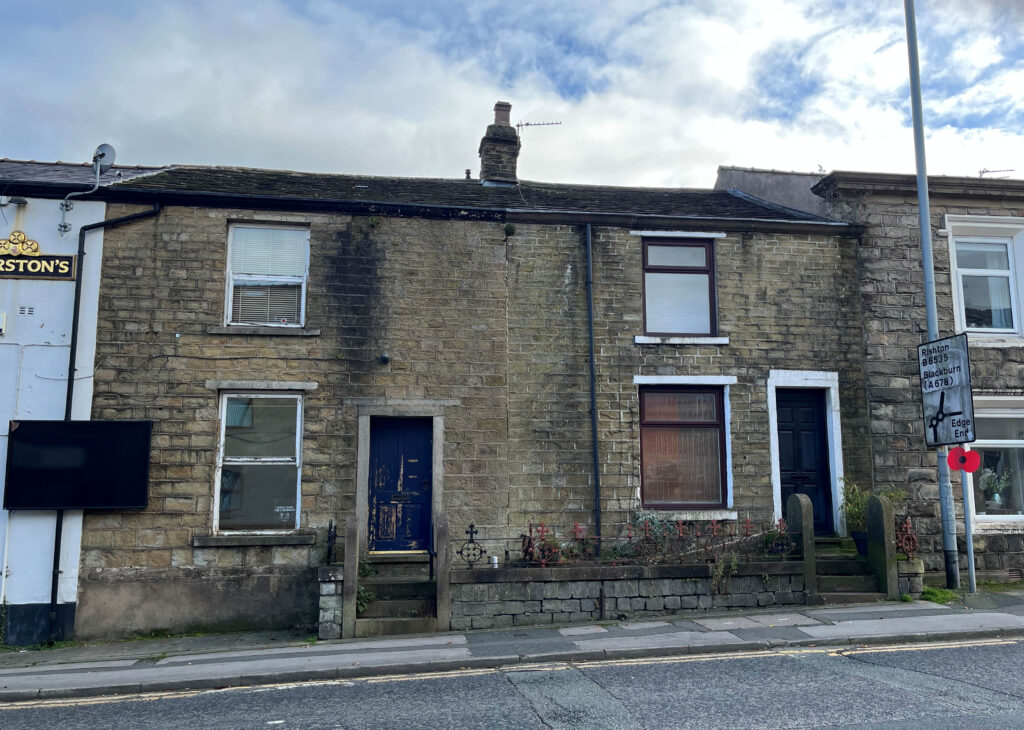
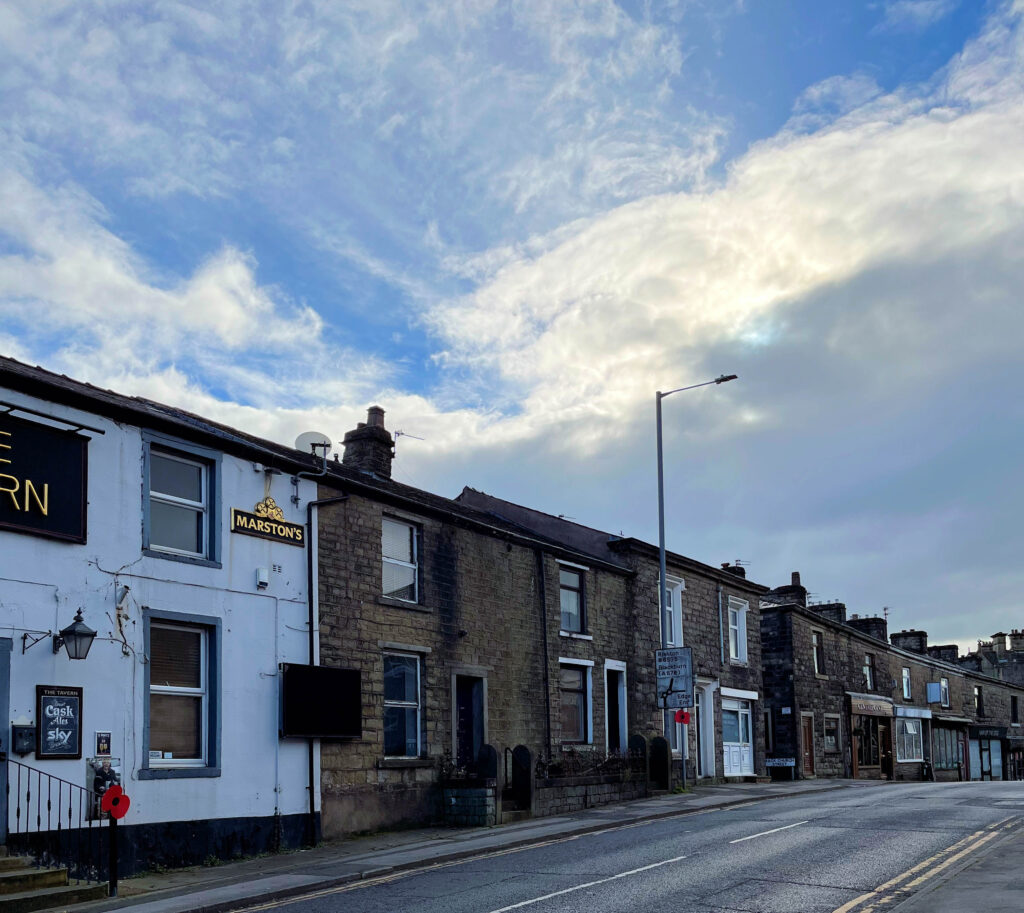
Numbers 24 and 22 Church Street
In 1841 John and Maria were living in Church Lane, Great Harwood. His occupation reads “block printing”. The children’s baptisms also show their father as a printer. There were problems with the economy and the Chartists were very strong in the area at that time. Between 1840 and 1842 factory owners cut wages by up to 25%. In 1842 there was a General Strike. In response to this, by 1851 John had become a draper, working from the parlour of the house.
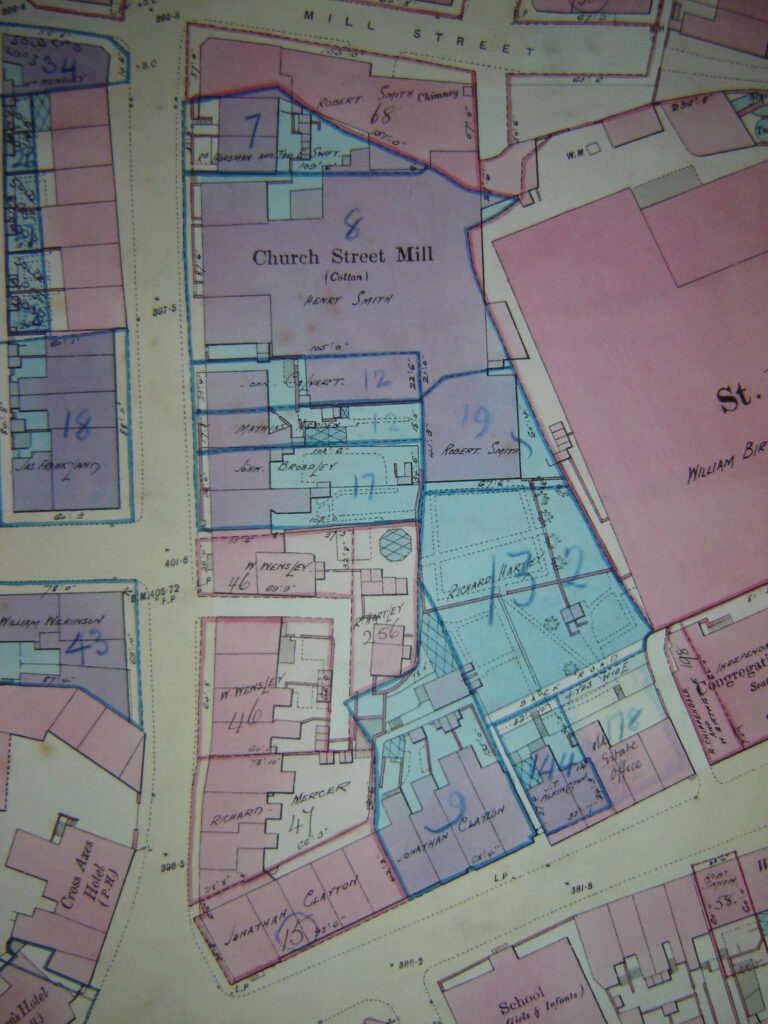
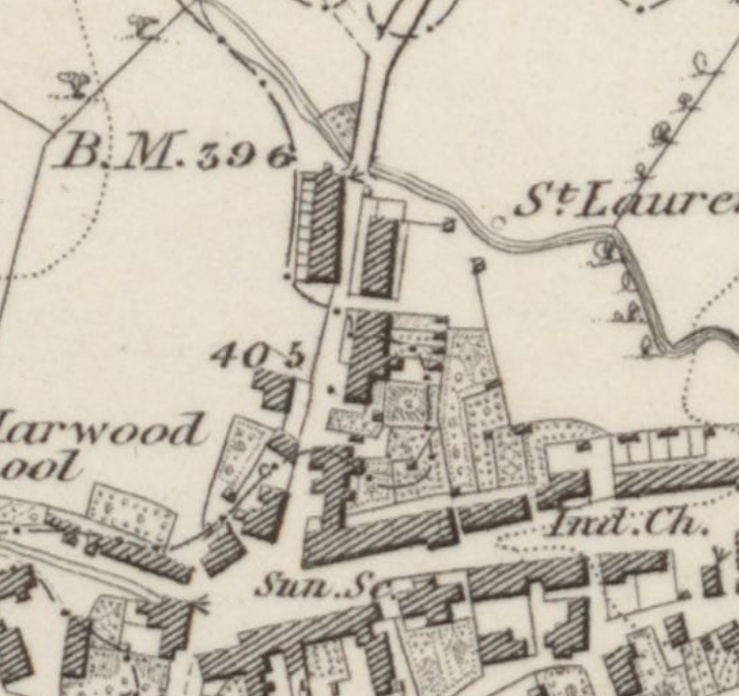
Map showing the area leased to John Broadley and the OS Map surveyed 1844 showing the houses on Church Lane.
OS Map Reproduced with the permission of the National Library of Scotland https://maps.nls.uk/
The 1841 and 1851 censuses show John’s house as simply Church Lane, but his house in 1861 is numbered 22 Church Street. Records in the Trappes-Lomax collection show that John had taken out a lease for land on Church Street in 1835 and maps from the same collection show that this was for what later became 22 and 24 Church Street, John not only built a house for himself but another to let out. He later took on leases on four more small plots of land, across the road on Cattle Street.
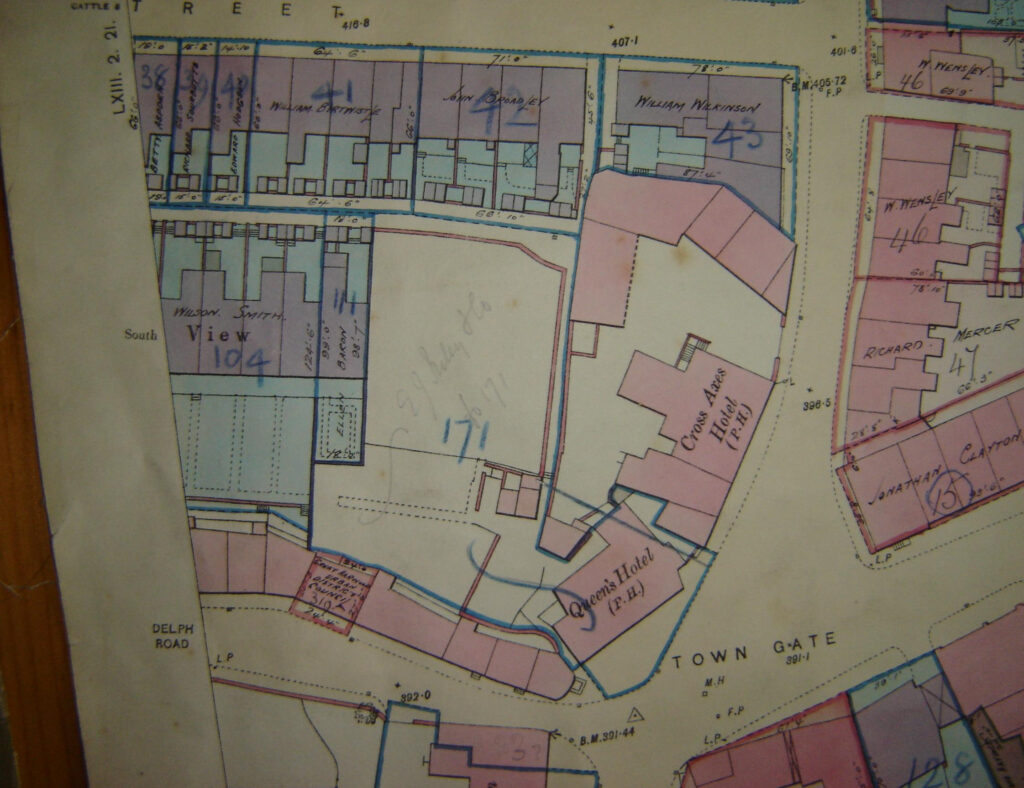
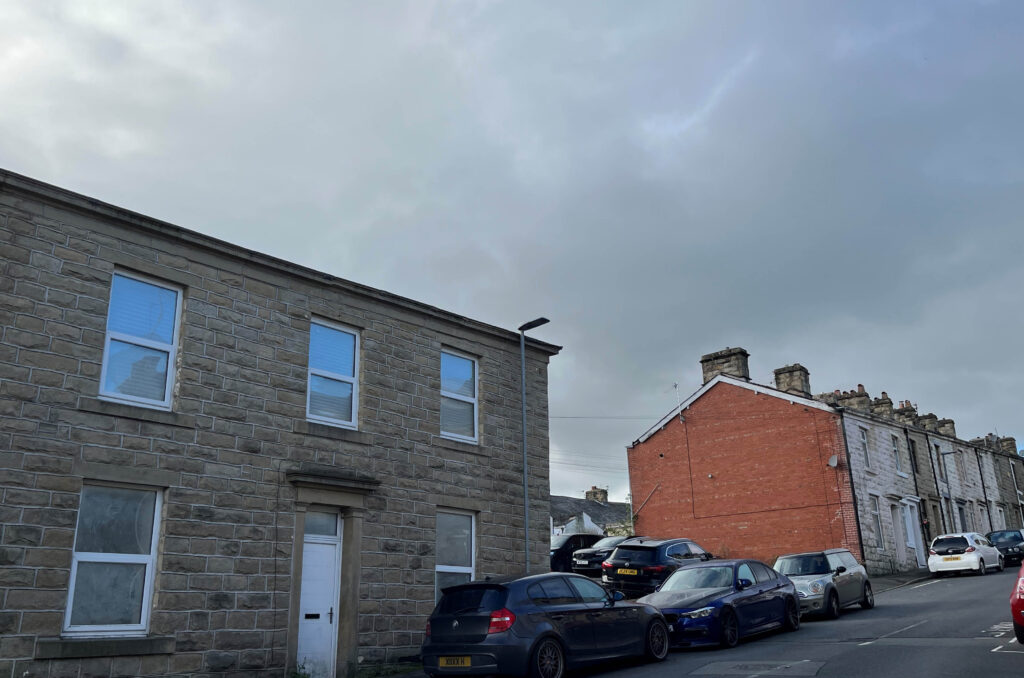
Map showing the second block of houses built by John Broadley and a photograph of where they used to stand on Cattle Street, just across the road from his house on Church Street.
Letters from Ada Clemesha in the 1950s (who subsequently lived in the house) to Helen Sullivan, John’s great-granddaughter mention many cupboards and one in particular which locked. She also notes steel sheets behind the front door and a bar across the chimney to prevent burglars. The downstairs rooms were stone flagged and there were stone stairs to the three bedrooms. Ada states that John was the only draper in town, when he set up in business.
Barbara Broadley Beinhocker also mentioned she had found “a booklet about the estate and funeral expenses of John Calvert of Church Lane, with notes about housing repairs and additions by John Broadley that would appear to appertain to 22 Church Street”.
Robert Holt, John’s brother in law, also changed his career from block printer in 1841 to that of draper in 1851. Which influenced the other, I do not know. Robert lived in Black Abbey St in Accrington. John’s older brother, Thomas, remained a calico printer in 1851 but had become a bookkeeper by 1861. However, Thomas was in at the inception of the Victoria Mill with John Carter in 1856, while Robert Holt was one of the partners in Wood Nook Mill. John Broadley of Great Harwood seems not to have joined his relatives in investing in mills. In a letter of 1868, he mentions shares in the gas and water company which pay good interest.
John’s eldest son James followed his uncle Peter Broadley to Rochdale and was apprenticed to him as a wheelwright (1841 census). James died young; his sons Edwin and Harry and his daughter Maria emigrated to America. The eldest, John, remained in Rochdale as a newsagent. Edwin left in 1870 for Pittsfield, Maine and married Ann Lord from Rochdale in 1871. They had a large family. Henry Birtwistle Broadley married Margaret Faulkner in Rochdale in 1878. He visited Edwin in 1871 and must have stayed some time as Edwin and Henry visited Hugh in 1872. I am not sure when Henry emigrated but he was naturalised in 1888 and died in Massachusetts in 1934. Maria married Thomas Chapman in 1877 in Rochdale and they emigrated in the 1880s to New Bedford, Massachusetts. The family in America visited one another and corresponded with one another.
Hugh Broadley, John the draper’s second son, emigrated to Salem in Massachusetts in 1850, where he adapted his training in textile engraving to emboss leather, founding a firm and making a living for his family. The US census called him an engraver of pebbled leather. Hugh was trained in textile engraving at Farnsworth and Catlow’s which went bankrupt in 1848. It became a weaving shop but burnt down in 1872. There are also hints that Hugh went to Glasgow before he emigrated and learnt how to do steel engraving from a Mr Buchanan. A letter from John Broadley the astrologer in 1878 says that he visited Glasgow last Whit and Mr Buchanan asked to be remembered to Hugh. Hugh worked in the textile mills in Massachusetts but in his spare time developed his pebbled leather. Barbara says he was not a businessman and it was his son John who put the business on a firm footing. Hugh died of a stroke. Barbara said that John turned it into an industry and owned two factories in Salem. He died at the age of 42 leaving four children who were sent to boarding schools. One of these was Barbara’s father.
John and Maria’s daughter Ellen had an illegitimate son, John, and died in 1851. John the astrologer grew up with his grandparents and called John Broadley the draper “father”. He married his cousin Sarah Ann, who was Peter Broadley’s daughter. The marriage ended in separation. Two sons died as toddlers and one child was stillborn. One daughter survived to adulthood. In a letter of 9 April 1891, he speaks of his visit to Hugh’s family ten years before as he writes to commiserate with his cousin John on Hugh’s death. At some time between then and 12 January 1892 he visited America again and writes to apologize to John for not seeing him. He had many jobs in his lifetime, but his main passion was astrology and that was how he would have preferred to earn his living.
John and Maria’s daughter Jane died in 1852. Although John and Maria had six children, five predeceased them and the sixth lived in America. John’s only link to Hugh in America was the letters they wrote and the newspapers they sent one another. The Blackburn Standard reported Maria’s death as “On the 5th instant at Great Harwood aged 63 years Maria wife of John Broadley draper.” (16 August 1865) John had a stroke in 1870 and needed help. John Broadley said he was “plaiged” to get into a railway carriage. Barbara suggested he was pleased, but I believe it means plagued, referring to the struggle with his lame leg.
The first surviving letter is from 1867 which says times are bad, but that Catterall and David Mercer’s mill is still standing, the first steam powered mills in Great Harwood A further letter says William Birtwistle and the Thompsons have bought that mill. In a letter of 1 July 1868 John mentions a factory at Enfield, formerly Clegg and Anderson, lately Leach and Taylor, which employed 800, had closed 3 weeks before owing £83,000. Other mills were only working four days a week. In 1871 John writes that they were building a railway through Great Harwood, which opened in 1877. All the mills in Enfield and Oakenshaw had failed bar two, but the mills in Great Harwood were doing well except the Britannia which closed two years before. Mark Noble had failed. In 1872 the cotton trade was fairly brisk but profits small. John the astrologer complained that the Co op was doing better than him in the drapery business. Robert Smith and son had concluded weaving. In 1873 John was asking his son Hugh about American coal. In England the price had gone from 7s to 22s per ton. In 1873 John says 1500 looms are standing idle in Great Harwood. John died 22 February 1876, but members of the family continued to keep in touch across the ocean. In 1878 there was a strike in England because cotton manufacturers had reduced wages by 10%.
John the draper made a success of his life in Great Harwood but his sons had to leave to make their living.
Descendants of John Broadley, draper of Great Harwood
Click or tap a name marked ▾ to fold or unfold that branch.
- Generation 1
- Generation 2 (children)
- Generation 3 (grandchildren)
- Spouse / partner
- John Broadley1800–1876Draper of Great Harwood
m. Maria Riding1803–1865James1824–1860
- m. (1) Ann Grindrod1826–1855
- John1846–1901The newsagent
- Edwin1848–1901
- Henry Birtwistle1850–1934
- Ellen Jane1853–1854
- Hugh1855–1855
- m. (2) Mary Rideoughb. 1824
- Maria1856–1892
- m. (1) Ann Grindrod1826–1855
Hugh1826–1890
- m. Johanna Keefe
- John1863–1907
- Mary Ellen1866–1947
- Mariab. 1867
- m. Johanna Keefe
Ellen1828–1851
- with Joseph Beck (not married)
- John1846–1913Illegitimate son
- with Joseph Beck (not married)
- Alice1832–1837
- David1836–1837
- Jane1841–1852